

The brown spots fade. The redness quiets. Tone evens out — session by session, until your skin reads rested instead of weathered.
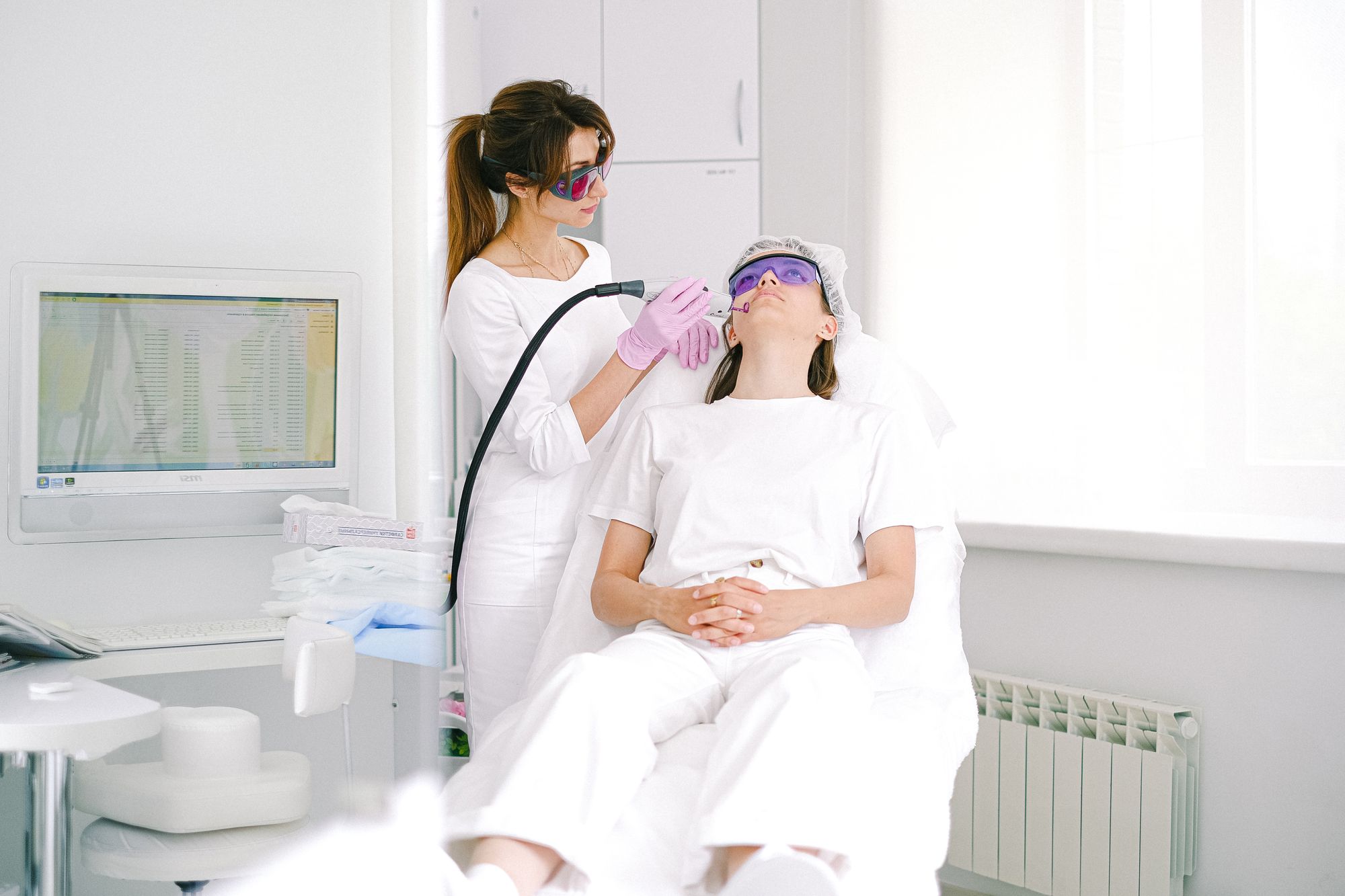
You settle in. A cool sapphire tip glides across your skin — quick, controlled pulses, a snap of warmth, the room smells faintly of summer. Thirty to sixty minutes later you walk out a little pink, with a clear sense of what just got softer.
Two wavelengths are doing the work — one tuned to pigment (the sun spots, the freckles you didn't ask for), one tuned to vessels and tone (the redness, the broken capillaries, the dullness that no serum quite fixes). Your clinician picks the mix on the day, against your face, your goals, your skin type.
The cooling tip is what makes it gentle enough to use on a wide range of Fitzpatrick skin types — and gentle enough that most patients describe it as a hot rubber-band flick, not a procedure.
Treated areas · Face · Neck · Décolleté · Hands · Legs
Who it helps.
Redness, pigment, and the kind of unevenness that doesn't respond to skincare — addressed in the same chair, with cooling built into every pulse.
Sun spots and redness and tone — handled in the same visit, so your plan flexes to whatever your skin actually needs that month.
The brown marks lift. The visible vessels quiet. Skin reads more even in photographs — and in person, where it counts.
The sapphire tip cools your skin a fraction of a second before each pulse fires. Most patients describe it as warm — not painful — and walk out without numbing.
Honest answers about comfort, downtime, and what a Clarity II series actually looks like — so you can plan around it instead of guessing.
Most patients describe it as a hot rubber-band flick — quick, warm, over before you brace. The sapphire tip cools your skin a half-second before each pulse, which is why we rarely need to numb. Areas with more pigment or vessels can feel a little sharper; we adjust on the day.
Pink for a few hours, like a brisk wind-burn. Sometimes the next morning too. Brown spots may darken into a coffee-ground texture for 5 — 10 days before they flake off — which is the point, not a problem. Makeup goes on the next day; sunscreen, every day.
Pigment usually shifts first — you'll notice spots lifting in 1 — 2 weeks. Redness and vascular changes settle over 3 — 4 weeks as the treated vessels resorb. The full effect of a series shows once all sessions are complete.
Most patients land in the 3 — 5 session range, spaced about four weeks apart. Heavier sun damage or stubborn redness can ask for more; lighter cases sometimes fewer. We map your plan at the consult so there are no surprises mid-series.
The dual wavelengths — alexandrite for lighter skin, Nd:YAG for deeper tones — let us treat across a wide range of Fitzpatrick types. We'll assess your skin in person and choose settings (or pivot to a different platform entirely) based on what's actually safe for you.
We'd rather you didn't be tanned going in or sun-exposed coming out — the laser targets pigment, and a fresh tan reads as a target. Most patients schedule fall through early spring, or commit to broad-spectrum SPF and shade in between sessions. Your clinician will give you the green or red light.
Every Clarity II plan starts with a skin-mapping consult — we look at your face, your goals, your history with the sun, and build the protocol around you instead of a default setting.

Plus: how we’d use a summer with the schedule on your side. One page, refreshed each month.
Read this month →