

A few minutes in the chair, a fine needle, no downtime — and a raised or keloid scar that quiets down and flattens visit by visit.
You come in for fifteen or twenty minutes. A small amount of Kenalog (triamcinolone acetonide) is placed precisely into the raised tissue with a fine needle — no incision, no downtime, back to your day.
Over the following weeks, the scar quiets — the itch and tightness ease first, then the height and firmness start to give. It's a slow softening, not an overnight one, which is why we work in a series.
Each visit, the dose is tuned to how your scar is responding — never one-size-fits-all. For deeper or older scars, Kenalog often pairs with surgical revision or resurfacing to address texture and pigment alongside the lift.
Commonly treated · Earlobes · Chest & Sternum · Shoulders & Upper Back · Jawline & Neck · Surgical & C-section Scars · Acne Scars
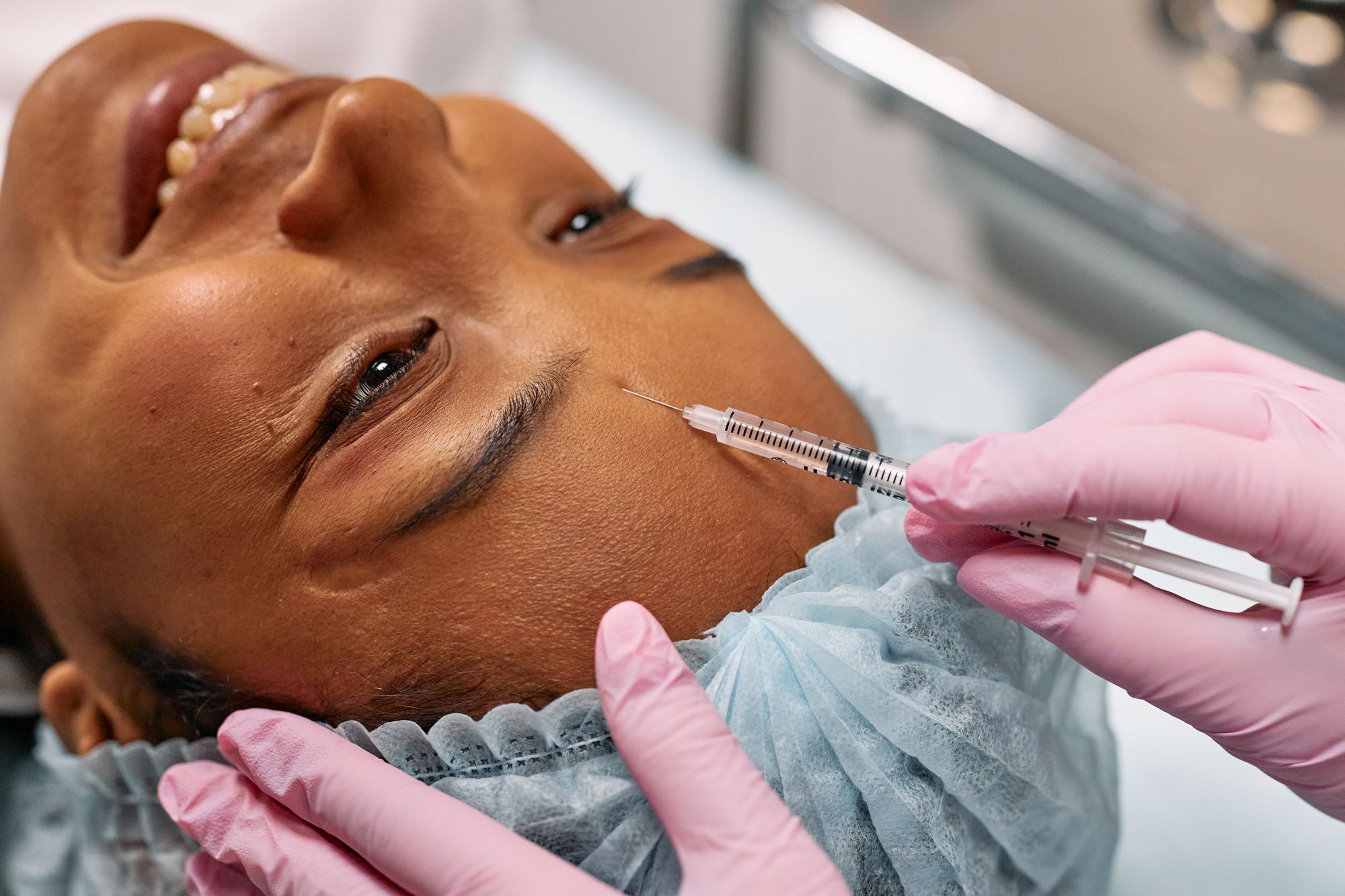
Who it helps.
Most patients come in for one of three reasons — a scar they want to stop seeing, an itch they want to stop feeling, or both.
Visit by visit, keloid and hypertrophic scars lose height and firmness — until the area reads as part of your skin again, not a feature on top of it.
The pulling, burning, on-and-off itch that thickened scars can carry tends to settle early — often before the visible change catches up.
Fifteen or twenty minutes, no downtime, no aftercare ritual. Repeated at intervals as your scar gives, never on a fixed schedule.
The questions we hear most often before a first Kenalog visit — answered plainly.
Honest answer — a firm, raised scar is dense tissue, so there's a pressure-and-sting moment as the medication goes in. We use a fine needle, work in tiny aliquots, and the discomfort is over in seconds. Topical numbing or ice helps for sensitive sites like earlobes; most patients say it's easier than they expected.
It depends on the scar — how old it is, how thick, and how it responds. Most patients plan on a series of three to six visits spaced four to six weeks apart, then taper as the scar softens. A small, fresh hypertrophic scar may settle in two or three. A long-standing keloid usually needs more — and sometimes pairs with revision or laser.
The itch and tightness often quiet within a few days — that's usually the first thing patients notice. The visible flattening lags behind: it builds gradually over four to six weeks after each visit, which is why we wait before the next dose. Progress is cumulative, not dramatic between any two appointments.
Keloids have a real tendency to recur — that's the nature of the tissue, not a failure of treatment. The goal is to get the scar quiet and as flat as it will go, then watch it. If it starts to re-thicken, a touch-up visit usually catches it early. Pairing Kenalog with surgical excision or pressure therapy lowers recurrence further for high-risk scars.
The most common ones are local and temporary — a small dimple or thinning of the surrounding skin if the dose lands too aggressively, or a lightening of pigment that usually resolves over months. This is exactly why we titrate the dose to your tissue and your skin tone, rather than giving everyone the same amount. Systemic effects are rare at the doses used for scars.
Often, yes — and often we should. For older or wider scars, pairing Kenalog with surgical revision, microneedling, fractional laser, or 5-FU can do more together than any one alone. The plan is built around your scar at the consult, not a default protocol.
We look at your scar — where it is, how long you've had it, how it's behaved before — and decide the dose from there. Precision is the whole point; the right amount matters more than the most.

Plus: how we’d use a summer with the schedule on your side. One page, refreshed each month.
Read this month →